Shallow Water Pipeline Installation Analysis
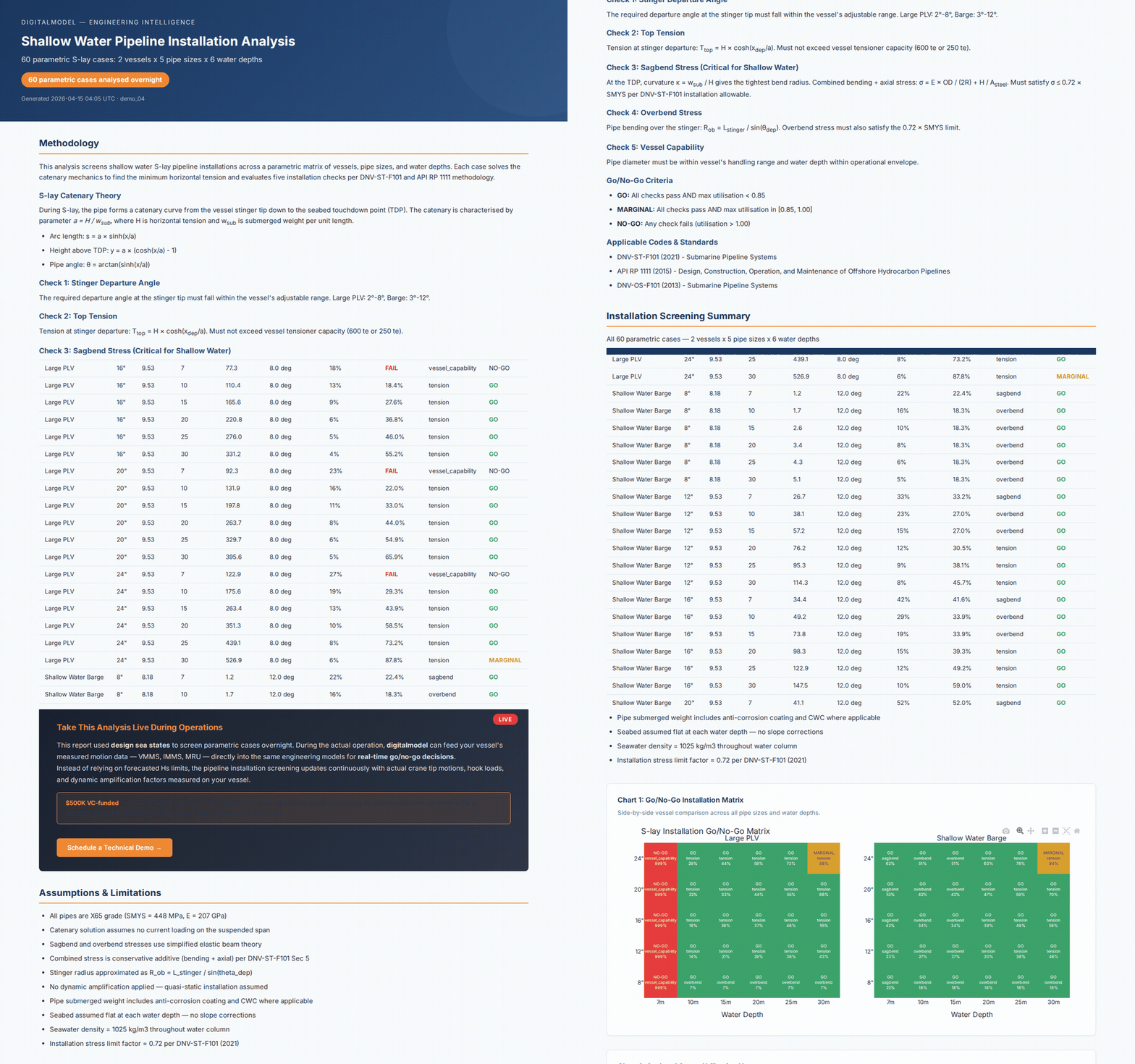
Methodology
This analysis screens shallow water S-lay pipeline installations across a parametric matrix of vessels, pipe sizes, and water depths. Each case solves the catenary mechanics to find the minimum horizontal tension and evaluates five installation checks per DNV-ST-F101 and API RP 1111 methodology.
S-lay Catenary Theory
During S-lay, the pipe forms a catenary curve from the vessel stinger tip down to the seabed touchdown point (TDP). The catenary is characterised by parameter a = H / wsub, where H is horizontal tension and wsub is submerged weight per unit length.
- Arc length: s = a × sinh(x/a)
- Height above TDP: y = a × (cosh(x/a) - 1)
- Pipe angle: θ = arctan(sinh(x/a))
Check 1: Stinger Departure Angle
The required departure angle at the stinger tip must fall within the vessel's adjustable range. Large PLV: 2°-8°, Barge: 3°-12°.
Check 2: Top Tension
Tension at stinger departure: Ttop = H × cosh(xdep/a). Must not exceed vessel tensioner capacity (600 te or 250 te).
Check 3: Sagbend Stress (Critical for Shallow Water)
At the TDP, curvature κ = wsub / H gives the tightest bend radius. Combined bending + axial stress: σ = E × OD / (2R) + H / Asteel. Must satisfy σ ≤ 0.72 × SMYS per DNV-ST-F101 installation allowable.
Check 4: Overbend Stress
Pipe bending over the stinger: Rob = Lstinger / sin(θdep). Overbend stress must also satisfy the 0.72 × SMYS limit.
Check 5: Vessel Capability
Pipe diameter must be within vessel's handling range and water depth within operational envelope.
Go/No-Go Criteria
- GO: All checks pass AND max utilisation < 0.85
- MARGINAL: All checks pass AND max utilisation in [0.85, 1.00]
- NO-GO: Any check fails (utilisation > 1.00)
Applicable Codes & Standards
- DNV-ST-F101 (2021) - Submarine Pipeline Systems
- API RP 1111 (2015) - Design, Construction, Operation, and Maintenance of Offshore Hydrocarbon Pipelines
- DNV-OS-F101 (2013) - Submarine Pipeline Systems
Installation Screening Summary
All 60 parametric cases — 2 vessels x 5 pipe sizes x 6 water depths
| Vessel | Pipe | WT (mm) | Depth (m) | T_top (te) | Depart. Angle | Sagbend Util | Max Util. | Gov. Check | Status |
|---|---|---|---|---|---|---|---|---|---|
| Large PLV | 8" | 8.18 | 7 | 2.7 | 8.0 deg | 10% | FAIL | vessel_capability | NO-GO |
| Large PLV | 8" | 8.18 | 10 | 3.9 | 8.0 deg | 7% | 7.0% | overbend | GO |
| Large PLV | 8" | 8.18 | 15 | 5.8 | 8.0 deg | 5% | 7.0% | overbend | GO |
| Large PLV | 8" | 8.18 | 20 | 7.7 | 8.0 deg | 3% | 7.0% | overbend | GO |
| Large PLV | 8" | 8.18 | 25 | 9.6 | 8.0 deg | 3% | 7.0% | overbend | GO |
| Large PLV | 8" | 8.18 | 30 | 11.5 | 8.0 deg | 2% | 7.0% | overbend | GO |
| Large PLV | 12" | 9.53 | 7 | 59.9 | 8.0 deg | 15% | FAIL | vessel_capability | NO-GO |
| Large PLV | 12" | 9.53 | 10 | 85.6 | 8.0 deg | 10% | 14.3% | tension | GO |
| Large PLV | 12" | 9.53 | 15 | 128.4 | 8.0 deg | 7% | 21.4% | tension | GO |
| Large PLV | 12" | 9.53 | 20 | 171.2 | 8.0 deg | 5% | 28.5% | tension | GO |
| Large PLV | 12" | 9.53 | 25 | 214.0 | 8.0 deg | 4% | 35.7% | tension | GO |
| Large PLV | 12" | 9.53 | 30 | 256.7 | 8.0 deg | 3% | 42.8% | tension | GO |
| Large PLV | 16" | 9.53 | 7 | 77.3 | 8.0 deg | 18% | FAIL | vessel_capability | NO-GO |
| Large PLV | 16" | 9.53 | 10 | 110.4 | 8.0 deg | 13% | 18.4% | tension | GO |
| Large PLV | 16" | 9.53 | 15 | 165.6 | 8.0 deg | 9% | 27.6% | tension | GO |
| Large PLV | 16" | 9.53 | 20 | 220.8 | 8.0 deg | 6% | 36.8% | tension | GO |
| Large PLV | 16" | 9.53 | 25 | 276.0 | 8.0 deg | 5% | 46.0% | tension | GO |
| Large PLV | 16" | 9.53 | 30 | 331.2 | 8.0 deg | 4% | 55.2% | tension | GO |
| Large PLV | 20" | 9.53 | 7 | 92.3 | 8.0 deg | 23% | FAIL | vessel_capability | NO-GO |
| Large PLV | 20" | 9.53 | 10 | 131.9 | 8.0 deg | 16% | 22.0% | tension | GO |
| Large PLV | 20" | 9.53 | 15 | 197.8 | 8.0 deg | 11% | 33.0% | tension | GO |
| Large PLV | 20" | 9.53 | 20 | 263.7 | 8.0 deg | 8% | 44.0% | tension | GO |
| Large PLV | 20" | 9.53 | 25 | 329.7 | 8.0 deg | 6% | 54.9% | tension | GO |
| Large PLV | 20" | 9.53 | 30 | 395.6 | 8.0 deg | 5% | 65.9% | tension | GO |
| Large PLV | 24" | 9.53 | 7 | 122.9 | 8.0 deg | 27% | FAIL | vessel_capability | NO-GO |
| Large PLV | 24" | 9.53 | 10 | 175.6 | 8.0 deg | 19% | 29.3% | tension | GO |
| Large PLV | 24" | 9.53 | 15 | 263.4 | 8.0 deg | 13% | 43.9% | tension | GO |
| Large PLV | 24" | 9.53 | 20 | 351.3 | 8.0 deg | 10% | 58.5% | tension | GO |
| Large PLV | 24" | 9.53 | 25 | 439.1 | 8.0 deg | 8% | 73.2% | tension | GO |
| Large PLV | 24" | 9.53 | 30 | 526.9 | 8.0 deg | 6% | 87.8% | tension | MARGINAL |
| Shallow Water Barge | 8" | 8.18 | 7 | 1.2 | 12.0 deg | 22% | 22.4% | sagbend | GO |
| Shallow Water Barge | 8" | 8.18 | 10 | 1.7 | 12.0 deg | 16% | 18.3% | overbend | GO |
| Shallow Water Barge | 8" | 8.18 | 15 | 2.6 | 12.0 deg | 10% | 18.3% | overbend | GO |
| Shallow Water Barge | 8" | 8.18 | 20 | 3.4 | 12.0 deg | 8% | 18.3% | overbend | GO |
| Shallow Water Barge | 8" | 8.18 | 25 | 4.3 | 12.0 deg | 6% | 18.3% | overbend | GO |
| Shallow Water Barge | 8" | 8.18 | 30 | 5.1 | 12.0 deg | 5% | 18.3% | overbend | GO |
| Shallow Water Barge | 12" | 9.53 | 7 | 26.7 | 12.0 deg | 33% | 33.2% | sagbend | GO |
| Shallow Water Barge | 12" | 9.53 | 10 | 38.1 | 12.0 deg | 23% | 27.0% | overbend | GO |
| Shallow Water Barge | 12" | 9.53 | 15 | 57.2 | 12.0 deg | 15% | 27.0% | overbend | GO |
| Shallow Water Barge | 12" | 9.53 | 20 | 76.2 | 12.0 deg | 12% | 30.5% | tension | GO |
| Shallow Water Barge | 12" | 9.53 | 25 | 95.3 | 12.0 deg | 9% | 38.1% | tension | GO |
| Shallow Water Barge | 12" | 9.53 | 30 | 114.3 | 12.0 deg | 8% | 45.7% | tension | GO |
| Shallow Water Barge | 16" | 9.53 | 7 | 34.4 | 12.0 deg | 42% | 41.6% | sagbend | GO |
| Shallow Water Barge | 16" | 9.53 | 10 | 49.2 | 12.0 deg | 29% | 33.9% | overbend | GO |
| Shallow Water Barge | 16" | 9.53 | 15 | 73.8 | 12.0 deg | 19% | 33.9% | overbend | GO |
| Shallow Water Barge | 16" | 9.53 | 20 | 98.3 | 12.0 deg | 15% | 39.3% | tension | GO |
| Shallow Water Barge | 16" | 9.53 | 25 | 122.9 | 12.0 deg | 12% | 49.2% | tension | GO |
| Shallow Water Barge | 16" | 9.53 | 30 | 147.5 | 12.0 deg | 10% | 59.0% | tension | GO |
| Shallow Water Barge | 20" | 9.53 | 7 | 41.1 | 12.0 deg | 52% | 52.0% | sagbend | GO |
| Shallow Water Barge | 20" | 9.53 | 10 | 58.7 | 12.0 deg | 36% | 42.4% | overbend | GO |
| Shallow Water Barge | 20" | 9.53 | 15 | 88.1 | 12.0 deg | 24% | 42.4% | overbend | GO |
| Shallow Water Barge | 20" | 9.53 | 20 | 117.5 | 12.0 deg | 18% | 47.0% | tension | GO |
| Shallow Water Barge | 20" | 9.53 | 25 | 146.8 | 12.0 deg | 15% | 58.7% | tension | GO |
| Shallow Water Barge | 20" | 9.53 | 30 | 176.2 | 12.0 deg | 12% | 70.5% | tension | GO |
| Shallow Water Barge | 24" | 9.53 | 7 | 54.8 | 12.0 deg | 62% | 62.4% | sagbend | GO |
| Shallow Water Barge | 24" | 9.53 | 10 | 78.2 | 12.0 deg | 44% | 50.8% | overbend | GO |
| Shallow Water Barge | 24" | 9.53 | 15 | 117.3 | 12.0 deg | 29% | 50.8% | overbend | GO |
| Shallow Water Barge | 24" | 9.53 | 20 | 156.4 | 12.0 deg | 22% | 62.6% | tension | GO |
| Shallow Water Barge | 24" | 9.53 | 25 | 195.5 | 12.0 deg | 17% | 78.2% | tension | GO |
| Shallow Water Barge | 24" | 9.53 | 30 | 234.7 | 12.0 deg | 15% | 93.9% | tension | MARGINAL |
Assumptions & Limitations
- All pipes are X65 grade (SMYS = 448 MPa, E = 207 GPa)
- Catenary solution assumes no current loading on the suspended span
- Sagbend and overbend stresses use simplified elastic beam theory
- Combined stress is conservative additive (bending + axial) per DNV-ST-F101 Sec 5
- Stinger radius approximated as R_ob = L_stinger / sin(theta_dep)
- No dynamic amplification applied — quasi-static installation assumed
- Pipe submerged weight includes anti-corrosion coating and CWC where applicable
- Seabed assumed flat at each water depth — no slope corrections
- Seawater density = 1025 kg/m3 throughout water column
- Installation stress limit factor = 0.72 per DNV-ST-F101 (2021)