VOL. I · NO. 1 · WEEKLY · WEB EDITION
The Deckhand Chronicle20 October 2026 · LAUNCH ISSUE
|
THE IDEA BEHIND EVERYTHING HERE
Start with the organisation you want to becomeHelping organisations reach their goals and become more successful starts with the outcome: which work matters, what could change, and what evidence would demonstrate progress.
Agents create room to reconsider how work is done. A useful starting point is four kinds of ambition: Speed, Altitude, Depth and Range.
Speed: Complete the same work in less time.
Altitude: Move up a level of abstraction, from an individual task to the outcome it serves.
Depth: Approach a task as a leading expert would, working deeper into the underlying data, tools and problems.
Range: Bring in knowledge, tools and techniques from several fields beyond the task’s usual discipline.
Speed: an installation contractor could set a goal of running its own installation analysis in-house within 24 hours. Depth: it could retain lookup tables and databases from operations, then investigate how those records could support live operations.
Altitude: an engineering firm could aim to take on more of its work by improving an existing calculation or reporting process. The goal is greater capacity, measured through elapsed time, rework and review findings.
These examples are goals. Operational use requires qualified inputs, checked methods and an accountable engineer.
How to be more ambitious: A tutorial for humans with models - 13 October 2026
|
SHORT READ
Ask big, then check the workDepth starts with the underlying inputs and methods. Give your assistant an outcome, a bounded scope and a checkable definition of done. Watch and check while the task runs at first: inspect the inputs, the first calculation and the saved output.
For a long task, set a checkpoint and check back in an hour. Look for completed cases, recorded exceptions and results read back from the actual output. Adapt that interval to the task.
Engineering stays precise and consistent through fixed units, governing criteria, repeatable checks and independent review. Keep a progress record so the next session can resume from evidence. The linked practice note describes progress records and end-to-end tests.
Engineering practice note: progress records and end-to-end checks
|
ENERGY STREET EDITION
Explore the engineering familiesOur repository ecosystem contains specialists: the code and checks that flow through its modules and libraries. Start with an engineering family, choose a module, then inspect the calculation code and its checks. Range brings methods from several families; Depth takes each question down to its data, tools and reference checks. One family is explored in each Energy Street issue.
Specialists edition - 17 October 2026What is new:
Numbered specialists connect each family to code and a named passing check.
Measured counts show 35 of 196 modules under the conservative counting rule.
Run dates and limits identify the evidence behind this edition.
Run order: data first, specialists next, independent checks last. For each study, record the inputs, units and governing criteria before calculation. Record the independent check separately; say when it did not run.
The counts cover modules with a clean run and a cited check that ran and passed on 17 October 2026. Checks limited to unit conversions or arithmetic sums are left out. Smoke checks, untested modules, failed runs and checks that did not run are also left out. The linked checks cover their stated cases; they do not establish project readiness. An independent study review was not run for this catalogue.
2. Cathodic protection0 of 1 modules. Run date: 17 October 2026 (UTC).
No module in this family has a checked engineering value yet.
|
3. Hydrodynamics and motions0 of 17 modules. Run date: 17 October 2026 (UTC).
No module in this family has a checked engineering value yet.
|
Explore the families in our public GitHub repositories. Ask your assistant to read this newsletter, inspect the public evidence, and judge which capabilities are realistic for your organisation today.
digitalmodel · worldenergydata · assetutilities
|
|
FROM THE PUBLIC LIBRARY
Four views of the workThese public views put Depth into practice: start with records, ask a bounded question and inspect the evidence. The library spans Wells and field development, Hydrodynamics and motions, Metocean and data, and Study automation and reporting.
Drilling HSE patterns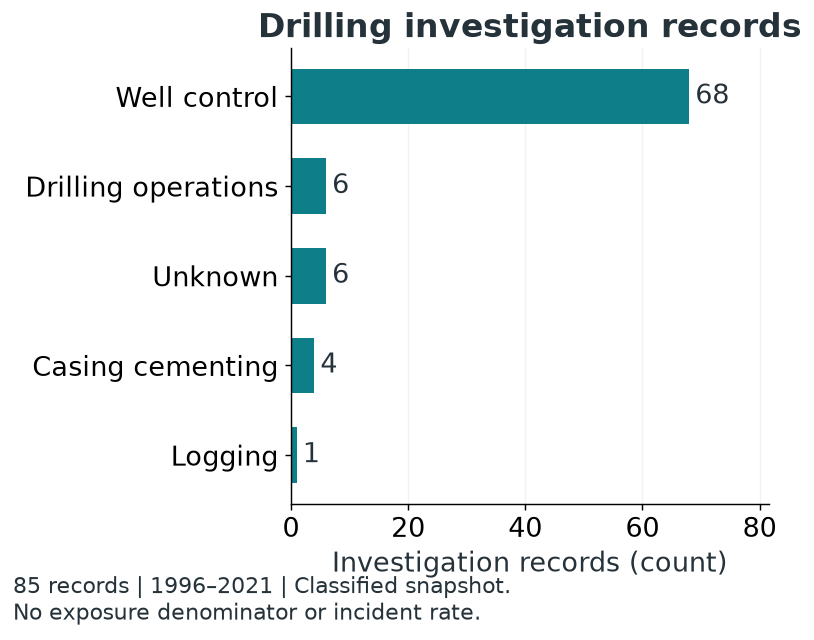 Well-control classifications: 68 of 85 records. The subset is selected mainly from blowout records, so well control is expected to lead.
85 classified investigation records, 1996-2021; no exposure denominator or incident rate. Well-control records dominate this investigated drilling subset. Counts identify questions for review; exposure-adjusted risk is not established. 85 classified BSEE investigation records, 1996–2021; selected historical snapshot, not an incident rate.
vamseeachanta/worldenergydata | reports/hse/drilling-hse-patterns-2026-07-05.json @b1394197 | 2026-07-06
Interactive page planned: /newsletter/charts/hse-drilling/
Field-development screening by water depth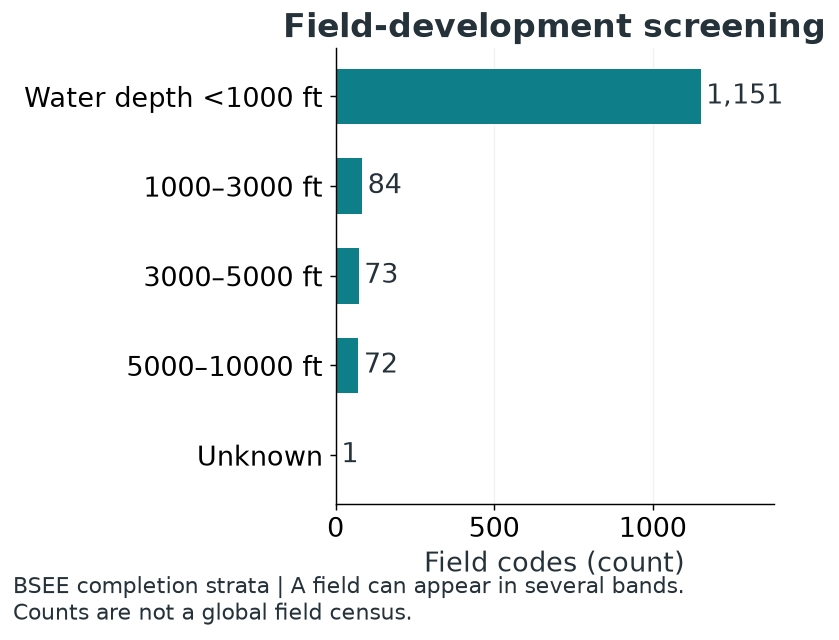 Depth provides an initial way to organise field-development questions.
Water depth less than 1,000 ft: 1,151 distinct field codes in this snapshot.
Fields can span depth bands; completion-record coverage does not select a development concept.
vamseeachanta/worldenergydata | docs/modules/bsee/analysis/completion_intervention/completion_strata.csv @b1394197 | 2026-10-14
Interactive page planned: /newsletter/charts/field-depth/
Well-completion record patterns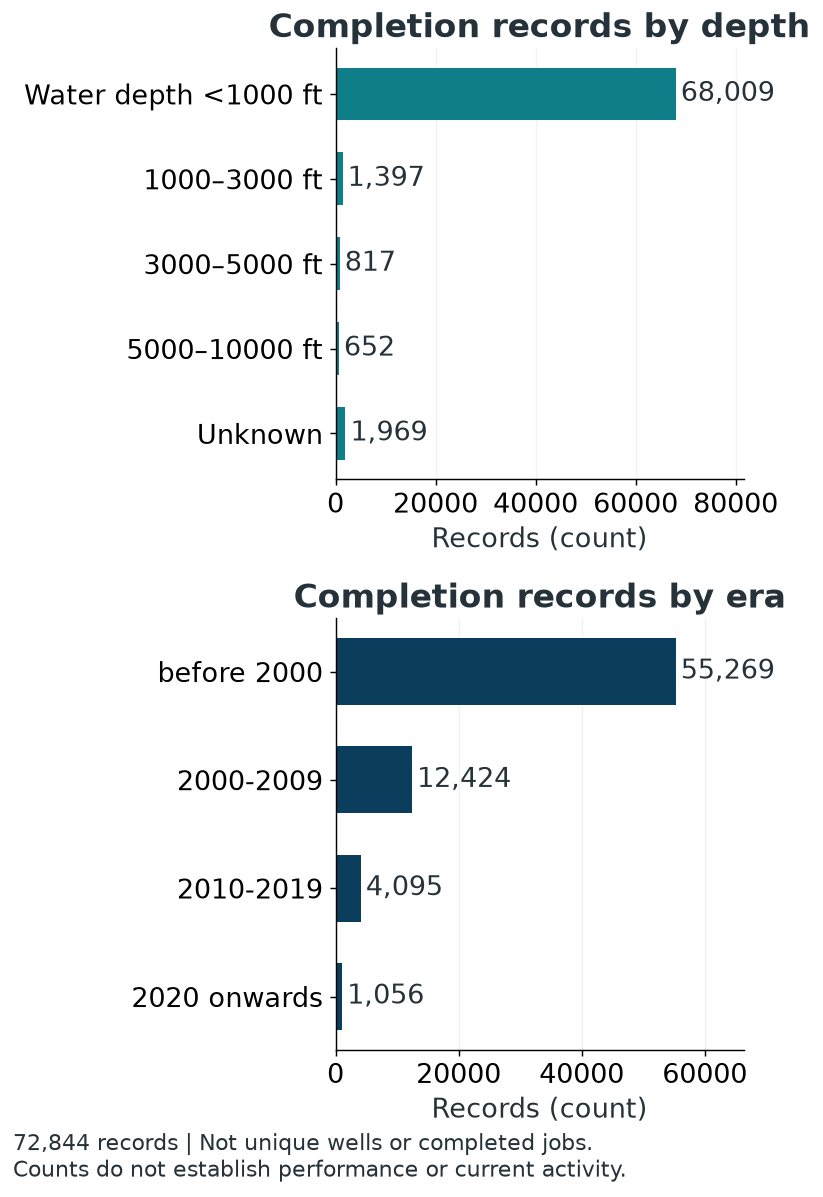 The same public completion records can be examined by depth and era.
Records before 2000: 55,269 of 72,844 records in the published strata.
Repeated records are not unique wells or completed jobs; reporting coverage differs by era.
vamseeachanta/worldenergydata | docs/modules/bsee/analysis/completion_intervention/completion_strata.csv @b1394197 | 2026-10-14
Interactive page planned: /newsletter/charts/completion-strata/
Heave-only diffraction comparison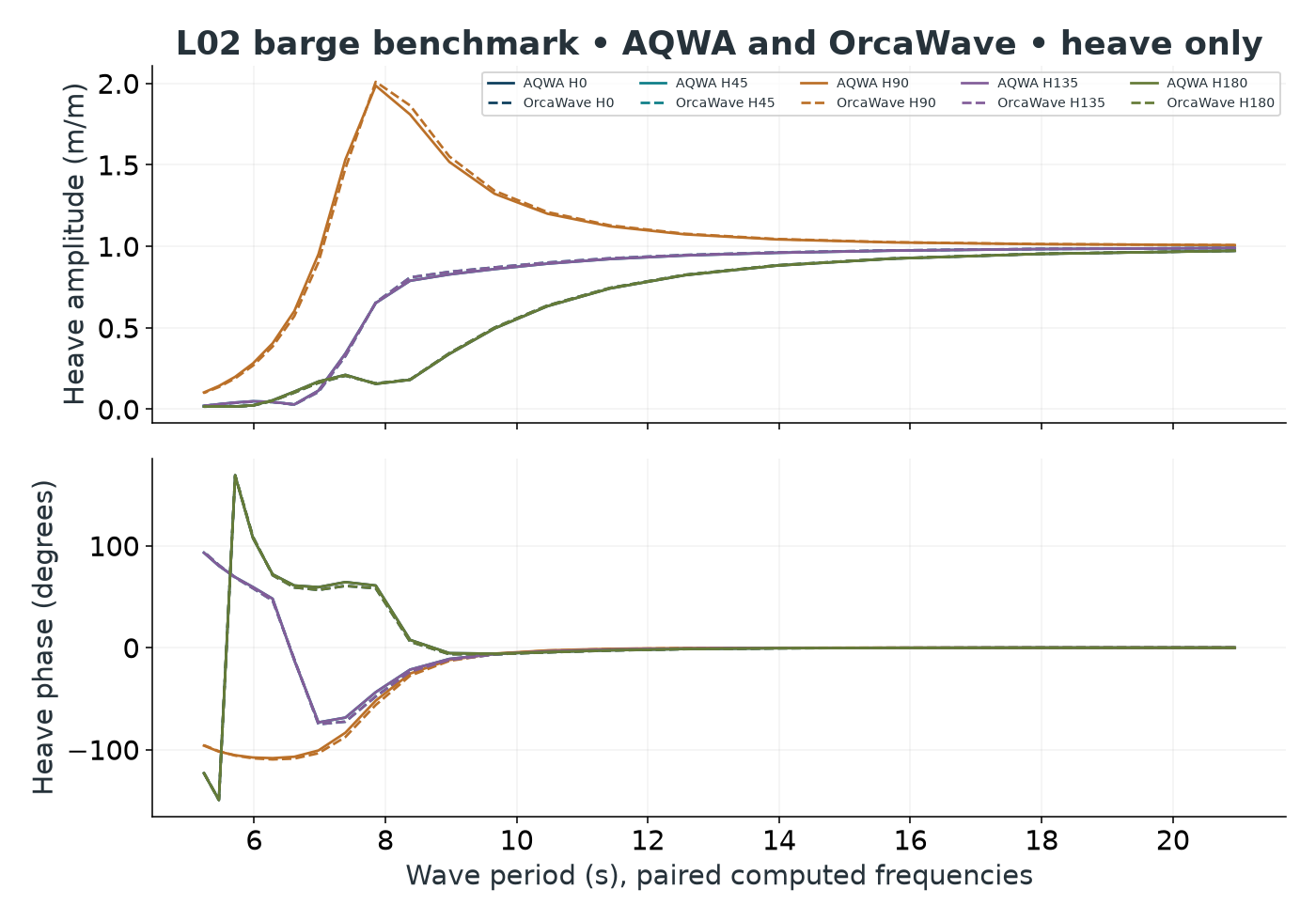 Heave agrees within 0.06 m/m in amplitude and 4.3 degrees in phase across the computed frequencies. The other five motions are still being reconciled; the overall comparison is not a match.
Maximum amplitude difference: 0.055 m/m; maximum phase difference: 4.25 degrees. Comparison run: 2026-02-09.
Heave only, 95 paired points per solver across five headings and 19 frequencies. The published overall rating for all six motions is poor, with split results.
vamseeachanta/digitalmodel | docs/domains/orcawave/L02_barge_benchmark/benchmark_results/benchmark_report.json @bd924737 | 2026-02-09
Interactive page planned: /newsletter/charts/diffraction-heave/
A comparison of the two diffraction programs is in progress.
The other engineering families: we will dive in later.
|
|
MAIN STREET: WHAT WE SET UP THIS MONTH
E-mail authenticationDone, 17 October 2026.
E-mail authentication records were added on 17 October: SPF, DKIM and DMARC. They help receiving systems identify authorised mail and reduce spoofing and spam placement; they do not establish inbox delivery for each message.
Do it yourself- Inventory the services authorised to send your company mail.
- Add the authentication records through the mail and domain administration tools.
- Check the published records and inspect authentication results on a test message.
|
One decisions pageDone, 17 October 2026.
One page gathers every open decision with a recommendation. The maintainer’s answers are saved in one click.
Do it yourself- Gather open decisions into one page, each with the recommended action and its reason.
- Provide a way to record the maintainer’s answer with the decision.
- Test an answer, reload the page and check that the recorded decision remains.
|
Done, 17 October 2026.
Duplicate contact entries were merged and consent was noted before the first send. A contact entry is not permission to send; only the recorded consent governs inclusion.
Do it yourself- Choose one authoritative contact register and compare duplicate entries.
- Merge duplicates without losing the consent record or any stop instruction.
- Inspect the proposed export against recorded consent before a separately approved send.
|
Coming next; end-to-end test not complete.
A website enquiry form to a shared support mailbox is coming next. Receipt and reply have not yet been established by an end-to-end test.
Do it yourself- Choose a shared mailbox and define who will handle incoming enquiries.
- Connect the website form using the existing website and mail tools.
- Submit a test enquiry, read it in the shared mailbox and verify the reply before calling it complete.
|
|
MAIN STREET EDITION
Automate the routine adminChoose the organisational goal first: fewer administrative interruptions or more time for engineering. This is Speed applied to routine work. Start with inputs and approval rules that can be written down. OpenAI’s gpt-realtime live voice release of 28 August 2025 added phone integration and remote tool connections. A caller’s request can become a draft task that someone checks and approves. If your phone or accounting tool includes these features, the steps below provide a starting point.
OpenAI live voice release - 28 August 2025
The steps: capture > check > approve.
Call handlingA spoken request can become a routed call or a draft follow-up task.
Do it yourself:
1. Write a one-page routing table: topics, covering team, opening hours and backup.
2. Enable speech recognition or live voice in the phone system; test routine and unclear requests.
3. Inspect the transcript and task record, check consent and retention settings, and keep a manual route.
|
InvoicingJob records can supply the fields for a draft invoice.
Do it yourself:
1. Choose a completed job and the approved quote as the source of customer, items and rates.
2. Enable draft invoices in the accounting tool; compare quantities, tax and totals with the source.
3. Approve a small checked sample before enabling reminders; keep invoice sending under approval.
|
TimesheetsA shared form can feed a checked weekly summary.
Do it yourself:
1. Create a form for date, job code and hours, using the existing rounding and overtime rules.
2. Connect it to a spreadsheet; flag missing days and totals outside the agreed limits.
3. Reconcile one week with the source records, then approve the payroll or job-cost export.
|
Expense reportsReceipt extraction can populate a draft expense line.
Do it yourself:
1. Use the receipt capture feature in the existing card or accounting app.
2. Check date, supplier, tax and total against the image; match the line to the card statement.
3. Apply the expense policy, route exceptions for review, and approve the checked export.
|
|
|
THE NEXT TEN ISSUES
The planned reading calendarPlanned order, with no issue in Thanksgiving week or over Christmas and New Year. It may move; tell us what you want sooner.
Oct 27 · Cathodic protection · Energy Street
Nov 3 · Call handling · Main Street
Nov 10 · Hydrodynamics and motions · Energy Street
Nov 17 · Invoicing · Main Street
Dec 1 · Asset integrity: fitness for service · Energy Street
Dec 8 · Timesheets · Main Street
Dec 15 · Structural and fatigue: fatigue · Energy Street
Jan 5 · Expense reports · Main Street
Jan 12 · Risers and mooring: drilling riser · Energy Street
Jan 19 · Your pick: the most requested · Both
|
|
THE DATE BOOK
MON NOV 2 – THU NOV 5 · Abu Dhabi
ADIPEC 2026, the energy exhibition and conference, at ADNEC.
SAT NOV 28 · Main Street
Small Business Saturday. Shop local, the Saturday after Thanksgiving.
MON NOV 30 · Atlantic basin
The Atlantic hurricane season officially ends. It runs June 1 to November 30.
WED DEC 2 · Houston
Houston Small Business Expo, 9:30 a.m. to 5 p.m.
TUE MAR 2 – SUN MAR 21, 2027 · Houston
Houston Livestock Show and Rodeo.
MON MAY 3 – WED MAY 5, 2027 · Houston
OTC 2027, the Offshore Technology Conference.
Dates checked against the organisers and official pages on 15 October 2026. Confirm with the organiser before you travel.
|
|
Use our public data. If you want help with any work—automation, AI automation or workflows—let us know.
support@aceengineer.com
|
|
|